
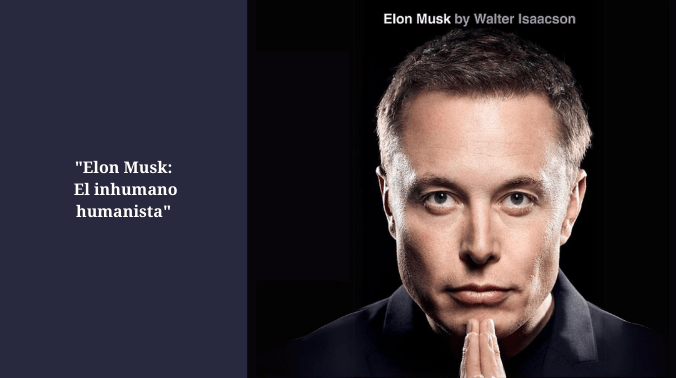
Today I want to share some thoughts that have come to me about leadership while reading the new biography on Elon Musk by Walter Isaacson. Without a doubt, Elon Musk is and will be one of the iconic figures in history. I admire his vision and his tenacity to face and provide the means to solve the great challenges facing humanity.
And yet, as I delve into his biography and see how he interacts with the people he works with, I wonder, how is it possible that he wants to save humanity and yet be so inhumane? And I believe the answer is that all human beings are a mixture of terrible saboteurs and a transcendent light that dignifies us.
To understand Elon Musk, it helps to delve into his life and understand his neurodiversity. It turns out he has a condition on the autism spectrum called Asperger's syndrome, which drives mathematical and intellectual development but affects his sense of compassion. If we add to that his upbringing in South Africa with a miserable father, we start to see a picture that explains a series of behaviors. Imagine, as a child, his father used to send him to a «survival» camp. They would throw the kids into the «jungle» to learn how to survive. They told the older kids to hit the younger kids and take their food. And they warned the younger kids not to be «idiots» like so-and-so, who died last year by giving up halfway through the exercise. Talk about a bullying culture!
Returning to the present. As I delve into his life and philosophy, I believe one of his most outstanding virtues is his pragmatic sense. He makes comments like, «physics doesn't give a damn if your feelings were hurt, what it cares about is whether the rocket gets to the moon.»
Without a doubt, the world requires different types of personalities and talents. And the greatness of Musk is indisputable. His transcendent sense of helping to solve humanity's imminent challenges makes him one of the most important figures of our time. He is dedicated to solving global warming through clean energy, and to making the human race a multi-planetary species in case we are so «stupid» that we destroy the Earth.
Now, to achieve his goals, Musk thrives on confrontation. And honestly, some of his “inhuman” outbursts seem absolutely necessary to me in a world of top executives who have become too comfortable in their spheres of power. For example, at a time when he was struggling with how to simplify and reduce the cost of installing solar panels, he demanded that the executives climb onto the roofs and install the solar panels themselves. He gives them an ultimatum that may seem absurd, but it’s the foundation upon which he’s achieved what he has. He tells them: «I want you to eliminate the 50% from the installation components and cut installation time in half, or I’ll fire you.» Climb up onto the roof and analyze every component and every step of the process; determine which steps and components are superfluous and can and should be eliminated. And what has happened time and time again in each of their companies when they’ve applied this kind of pressure? They’ve made exponential strides that are transforming the world.
In short, this book, like all great biographies, is enriching. Understanding how other human beings face great challenges and achieve outstanding results opens our eyes and sparks our appetite and imagination. Here is the challenge: How can we apply this tenacity towards improvement in all processes within our company, without generating the personal and human wear and tear that it causes?
Let's get to work.